Intro: The Call That Ruins Every Vacation
You're three days into a long-overdue vacation. First real break in months. And your phone rings.
It's someone from the business. "Quick question..."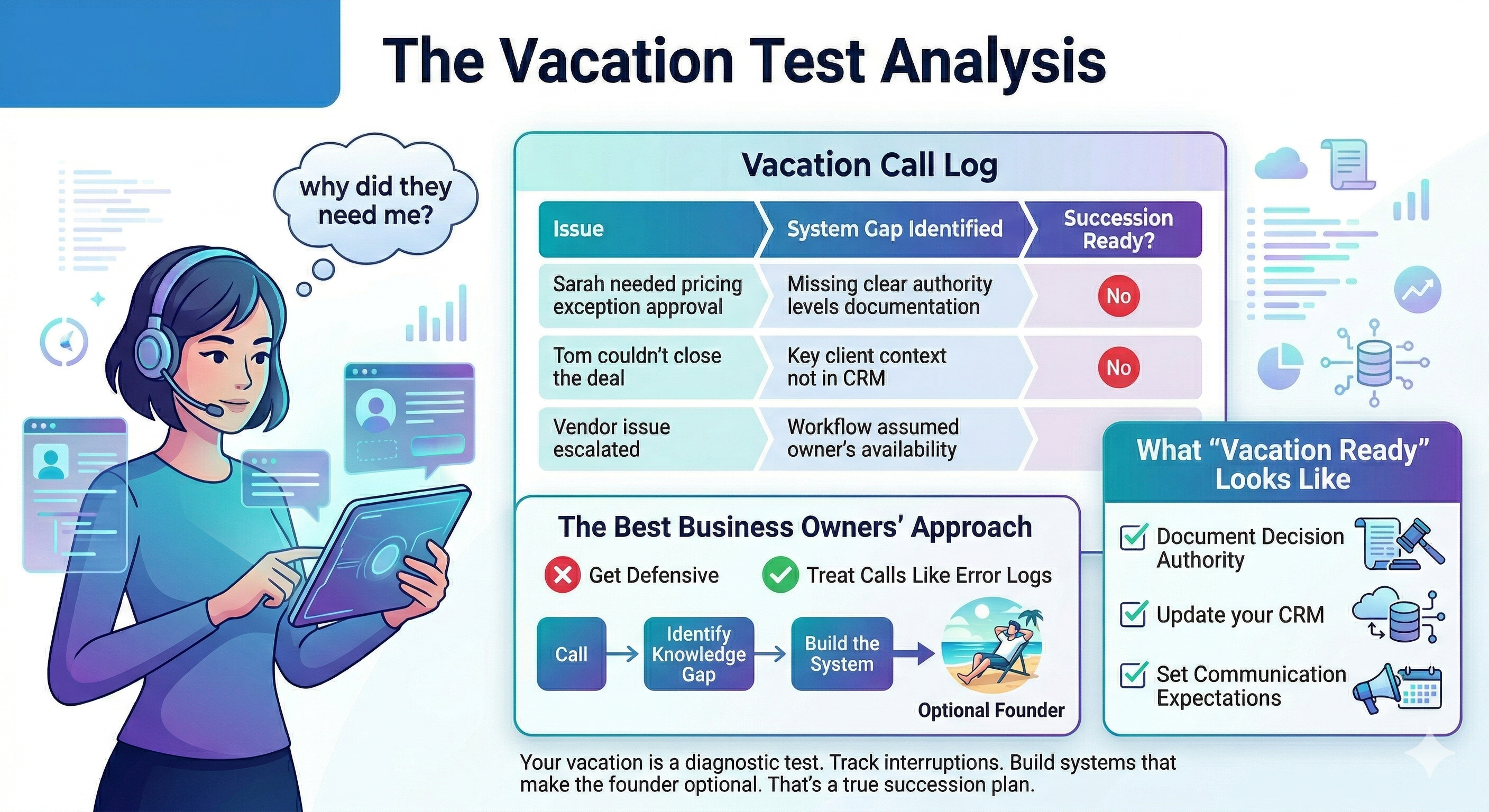
How many times did this happen on your last vacation?
Zero? You're rare—and you've built something special.
Once or twice for genuine emergencies? Normal and healthy.
Daily? Multiple times a day? That's not dedication. That's a dependency problem. And it's a clear signal your succession plan isn't a plan—it's a countdown to chaos.
Time away from your business isn't a luxury. It's a diagnostic test. And most family businesses are failing it.
Every Call Is a Data Point
When someone calls you on vacation, they're telling you something important. Not about them—about your systems.
Each call reveals:
• A knowledge gap - information that lives in your head instead of your CRM
• A decision dependency - judgment calls that can't happen without you
• A relationship monopoly - clients who will only talk to you
• A process hole - workflows that break when you're not there
The best business owners I know don't get defensive about these calls. They treat them like error logs.
"Why did Sarah need to call me about the pricing exception?"
→ Because we don't have clear authority levels documented
"Why couldn't Tom close that deal without me?"
→ Because key client context isn't in the system
"Why did that vendor issue escalate?"
→ Because our escalation process assumed I'd always be available
Your vacation isn't really about rest. It's about stress-testing the infrastructure your successor will inherit.
The Three Questions Every Call Should Answer
When someone from the business reaches out while you're away, ask yourself:
1. Should this have required me?
Some decisions genuinely need the owner. Strategic pivots. Major investments. Firing a long-term employee.
But most don't. Most calls happen because:
• The information wasn't accessible
• The authority wasn't clear
• The confidence wasn't there
Your CRM should document the first. Your org structure should clarify the second. Your leadership development should build the third.
2. What system would have prevented this call?
Every interruption points to a missing system:
• Client history not documented → They called you for context
• Pricing authority unclear → They called you for approval
• Vendor relationship knowledge in your head → They called you for the contact
Build the system. Next vacation, that call doesn't happen.
3. Does my successor know how to handle this?
This is the succession question that matters.
Not "could they figure it out eventually?" but "do they have what they need RIGHT NOW?"
If the answer is no, your succession timeline just got longer.
What "Vacation Ready" Actually Looks Like
The businesses that survive succession don't just pick a successor and hope for the best. They build infrastructure that makes the founder optional.
Here's what that looks like in practice:
Before You Leave:
✅ Document decision authority - What can each person approve without you? Put it in writing.
✅ Update your CRM - Key client contexts, relationship history, pending issues. If it's in your head, it needs to be in the system.
✅ Set communication expectations - "Call me for X. Don't call me for Y. If you're unsure, talk to [name] first."
While You're Gone:
✅ Track interruptions - Every call, text, or email. Don't just respond—log it.
✅ Resist the urge to micromanage - Let small fires burn if they're not catastrophic. Your team needs to learn.
✅ Ask > AeyeCRM Social - Ava: "why did they need me?" - Not to blame, but to diagnose the system gap.
When You Return:
✅ Review the interruption log - What patterns emerge?
✅ Build systems to fill the gaps - Documentation, training, authority delegation, CRM updates
✅ Schedule the next test - Three months later, take another week off. Measure improvement.
Your CRM Should Make You Less Necessary
Most CRMs are designed to make salespeople more effective. That's fine if you're scaling a sales team.
But family businesses need something different. Your CRM should make you less necessary.
That means tracking:
• Decision history - Why did we give that client a discount? Why did we pass on that opportunity?
• Relationship context - Who knows whom? What's the personal connection? Who should be looped in?
• Knowledge transfer progress - What has the successor learned? What gaps remain?
• Operational continuity - If you left tomorrow, what would break?
When your successor steps in, they shouldn't have to rebuild your mental model from scratch. Your CRM should be the institutional memory that makes the transition possible.
The Goal: Be Optional, Not Replaceable
Here's the paradox: the less your business needs you, the more valuable you become.
When you're optional:
• You can take a real vacation
• You can evaluate acquisition offers objectively
• You can step into the strategic role instead of firefighting daily operations
• Your successor can lead confidently instead of constantly second-guessing
When you're irreplaceable:
• You're trapped
• Your business has no enterprise value
• Your succession timeline is dictated by crisis, not choice
• Your legacy is at risk
The best family business owners I know aren't trying to make themselves obsolete. They're trying to make themselves optional.
And the only way to know if you're there? Leave. Watch what happens. Fix what breaks.
Then leave again.
Start With One Week
You don't need to disappear for a month to run this test. Start with one week.
Set clear expectations. Document what's needed. Turn on your out-of-office.
Then pay attention. Not to whether things go perfectly—they won't. But to what breaks and why.
Every gap you discover is a gift. It's a problem you can fix now instead of leaving it for your successor to discover in crisis mode.
Your business doesn't need you to be a hero. It needs you to build a system that works when you're not there.
The vacation test will show you how far you have to go.
Ready to build a CRM that makes you optional?
Contact us to see how AeyeCRM helps family businesses document what matters, delegate with confidence, and build succession plans that actually work.